 |
| Clouded Sulfur on Sage plant |
Showing posts with label Butterflies. Show all posts
Showing posts with label Butterflies. Show all posts
Wednesday, November 16, 2016

Saturday, October 22, 2016
Gray Hairstreak
 | ||
| Gray Hairstreak (Strymon melinus) on Gregg's Mistflower (Conoclinium greggii) |
Monday, May 18, 2015
McKinney State Park
On Easter Sunday, Roberta and I went to McKinney Falls State Park with the Beags (aka Beagle, aka Lilly - one of Roberta's dogs). The goal of the trip was for Roberta to take some pictures with her camera for her 365 project, but I figured I might as well take my camera and take some photos as well.
 |
| Rebel XTi - Trees by the lower falls. Notice the rock overhang on the right - the fact that the water has eroded away the rock means that this area floods with some regularity. This is also part of the reason why if you're in the tent camping area there's a sign which tells you to immediately run to higher ground if you hear the air sirens go off cuz it means a flood's a' comin'. |
 |
| Rebel XTi - Onion Creek by the tent camping sites. |
 |
| Rebel XTi - Spiderwort flowers |
 |
| Rebel XTi - Tree trunk. |
 |
| Cell phone - Roberta taking a picture of the bluebonnets. |
 |
| Cell phone - Beags is not impressed with the bluebonnets. |
 | ||
| Cell Phone - Roberta had Beags sit on a picnic table which had sidewalk chart art on it - apparently some of it rubbed off. |
 |
| Cell phone - Luna moth. I think this poor guy was getting ready to leave this mortal coil considering that he was completely non-concerned about us taking photos of him. Of course, Luna moth adults only live for about a week. |
Wednesday, December 10, 2014
Farewell, Queens
The queen butterflies finally emerged on November 25, and I released them the next day - a male and a female. These are the last of my foster caterpillars for the year.
The butterflies sunned themselves for a few hours before taking off.
As I headed back inside, I checked the milkweed plant.
Uh oh...looks like we have a few more left for the season.

 |
| Female Queen Butterfly |
 |
| Male Queen Butterfly. You can tell the difference because the male has the scent spot (i.e. white spot) on his hind wing. |
The butterflies sunned themselves for a few hours before taking off.
As I headed back inside, I checked the milkweed plant.
Uh oh...looks like we have a few more left for the season.
Wednesday, December 3, 2014
Hello, Friend.
A Praying Mantis Study:


You know, I don't know if that was a shell or if there was a butterfly to emerge from that chrysalis (it's gulf fritillary, by the way).
You know, I don't know if that was a shell or if there was a butterfly to emerge from that chrysalis (it's gulf fritillary, by the way).
Saturday, November 8, 2014
Moar 'Pillars!
So, last we left off, we had a few goobered chrysalises, a fritillary chrysalis that wouldn't stick, a new housing container to try and a few black swallowtail caterpillars.
First the updates:
There was one goobered chrysalis actually looked like it might turn out okay so I left it be. It eventually turned black like it was going to emerge, but it never did. I even left it out in the sun on the weekend hoping that would help.

Then there was the fritillary chrysalis that I had to tie to a twig. It did eventually hatch, but one of the forewings was goobered:

For comparison, it should have looked like this:

The little bugger couldn't fly, but since it could eat perfectly fine, I took him outside and put him on some flowers so he could live out the rest of his little life.
Then there were the black swallowtail caterpillars. The lighter of the two (i.e. the one that looked more like a regular black swallowtail caterpillar) ended up dying - it just stopped eating and then turned to mush. The darker one, however, remained fine.

A few days after I took the above picture, I put him in a yogurt cup house with a few skewers in it (for him to have something to attach to). A day or so after being moved, he formed a chrysalis. He's now ensconced in the laundry basket home waiting to hatch.
And finally, the update on the new housing container - I was going to let the monarch hatch in the yogurt cup, but because I was going to be gone for the whole day, I opted to take the lid off and leave the chrysalis outside to hatch. I just used two clothespins to pin the lid (with chrysalis) to a tomato cage. It must have worked because when I came home, the chyrsalis was empty.

And now for the NEW stuffs!
One of the days when I was outside collecting milkweed leaves for the monarch caterpillars, I saw a bunch of Queen butterflies flitting about and figured that meant that I'd end up with queen caterpillars on the milkweed. Sure enough, about 10 minutes later, there was a queen working the milkweed plants, so I took some of the leaves with eggs off and brought them inside to hatch and raise.
Queen caterpillars are also yellow, black, and white but the pattern is a little different; but the most easily seen thing that lets you know you have queens instead of monarchs is the 3 sets of antenna-looking things instead of only 2. This picture is probably of the 4th instar (the antenna things don't really form until the 3rd instar...but of course, some of that is they're tiny little buggers until about the 3rd instar - seriously - the first instar was about a millimeter long), and I've since moved them into the now empty yogurt containers for chrysalis formation.

I swear I'm almost done with the caterpillar updates - I'll probably stop after these guys hatch. Maybe. No promises.
First the updates:
There was one goobered chrysalis actually looked like it might turn out okay so I left it be. It eventually turned black like it was going to emerge, but it never did. I even left it out in the sun on the weekend hoping that would help.
Then there was the fritillary chrysalis that I had to tie to a twig. It did eventually hatch, but one of the forewings was goobered:

For comparison, it should have looked like this:
The little bugger couldn't fly, but since it could eat perfectly fine, I took him outside and put him on some flowers so he could live out the rest of his little life.
Then there were the black swallowtail caterpillars. The lighter of the two (i.e. the one that looked more like a regular black swallowtail caterpillar) ended up dying - it just stopped eating and then turned to mush. The darker one, however, remained fine.
A few days after I took the above picture, I put him in a yogurt cup house with a few skewers in it (for him to have something to attach to). A day or so after being moved, he formed a chrysalis. He's now ensconced in the laundry basket home waiting to hatch.
 |
| Black Swallowtail chrysalis from the side. |
 | ||
| Black Swallowtail chrysalis from the front. |
And finally, the update on the new housing container - I was going to let the monarch hatch in the yogurt cup, but because I was going to be gone for the whole day, I opted to take the lid off and leave the chrysalis outside to hatch. I just used two clothespins to pin the lid (with chrysalis) to a tomato cage. It must have worked because when I came home, the chyrsalis was empty.
And now for the NEW stuffs!
One of the days when I was outside collecting milkweed leaves for the monarch caterpillars, I saw a bunch of Queen butterflies flitting about and figured that meant that I'd end up with queen caterpillars on the milkweed. Sure enough, about 10 minutes later, there was a queen working the milkweed plants, so I took some of the leaves with eggs off and brought them inside to hatch and raise.
Queen caterpillars are also yellow, black, and white but the pattern is a little different; but the most easily seen thing that lets you know you have queens instead of monarchs is the 3 sets of antenna-looking things instead of only 2. This picture is probably of the 4th instar (the antenna things don't really form until the 3rd instar...but of course, some of that is they're tiny little buggers until about the 3rd instar - seriously - the first instar was about a millimeter long), and I've since moved them into the now empty yogurt containers for chrysalis formation.
I swear I'm almost done with the caterpillar updates - I'll probably stop after these guys hatch. Maybe. No promises.
Saturday, October 25, 2014
The Queen is Dead, Long Live the Queen
So I successfully kept 13 monarch caterpillars which turned into monarch butterflies.
I decided to try gulf fritillaries - one of which I accidentally smushed between the screen and edge of the tupperware container one day when I was changing the food for the remaining caterpillars (which included an additional 5 monarch caterpillars and another gulf fritillary). The remaining fritillary went into chrysalis, which was fine and dandy, but the silk holder thingy isn't as copious as the monarch ones and so as I was trying to move it to the "hatching cage," it wouldn't stick to the pin and I had to tie it up with thread. So we'll have to see if it works.

Then I started having problems with the monarch caterpillars; they did okay until it was time to pupate. The first one didn't form a proper chrysalis - it was fully chrysalized, but it was like it was only half formed. The bottom half looked normal, but the top half, while chrysalized, looked just like a caterpillar encased in a green case.

The second caterpillar only half chrysalized. The third decided to attach to the side of the tupperware instead of from the screen on top, so I've left it in place and moved the entire tupperware to the hatching cage (it may or may not make it to hatching - I've read that when they have a flat side in their chrysalis that it means the butterfly will likely be deformed). The fourth, thankfully, formed a normal chrysalis on the screen (which I have since moved to the hatching cage with a straight pin). The fifth, I put in a mini-hatching container made out of one of the large yogurt containers. The hatching container is good for hatching, but the poor thing won't be able to fly in it, so I obviously have to pay attention and let the butterfly out shortly after it hatches.

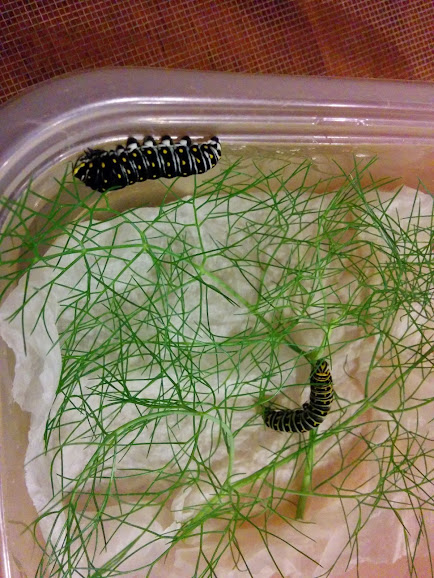
I noticed that my fennel plant had a bunch of eastern black swallowtail caterpillars on it, so I decided to try them as well - now with those I'll have to add some sticks to the containers so they can attach properly since they end up at a 45 degree angle from whatever they attach to.
Swallowtails are cool because when the caterpillars are in the first 2 instars, they look like this:

By the 4th instar, they look like this (though admittedly the one in the foreground is more black than I'm used to seeing):
And of course, lest I think that I just suck at this, and the cats in the wild do better, here is a photo of a poor fritillary butterfly that didn't make it fully out of its chrysalis.

 |
| Monarch butterfly just after emergence. The abdomen pulses and fills the wings with fluid. |
I decided to try gulf fritillaries - one of which I accidentally smushed between the screen and edge of the tupperware container one day when I was changing the food for the remaining caterpillars (which included an additional 5 monarch caterpillars and another gulf fritillary). The remaining fritillary went into chrysalis, which was fine and dandy, but the silk holder thingy isn't as copious as the monarch ones and so as I was trying to move it to the "hatching cage," it wouldn't stick to the pin and I had to tie it up with thread. So we'll have to see if it works.
Then I started having problems with the monarch caterpillars; they did okay until it was time to pupate. The first one didn't form a proper chrysalis - it was fully chrysalized, but it was like it was only half formed. The bottom half looked normal, but the top half, while chrysalized, looked just like a caterpillar encased in a green case.
The second caterpillar only half chrysalized. The third decided to attach to the side of the tupperware instead of from the screen on top, so I've left it in place and moved the entire tupperware to the hatching cage (it may or may not make it to hatching - I've read that when they have a flat side in their chrysalis that it means the butterfly will likely be deformed). The fourth, thankfully, formed a normal chrysalis on the screen (which I have since moved to the hatching cage with a straight pin). The fifth, I put in a mini-hatching container made out of one of the large yogurt containers. The hatching container is good for hatching, but the poor thing won't be able to fly in it, so I obviously have to pay attention and let the butterfly out shortly after it hatches.
I noticed that my fennel plant had a bunch of eastern black swallowtail caterpillars on it, so I decided to try them as well - now with those I'll have to add some sticks to the containers so they can attach properly since they end up at a 45 degree angle from whatever they attach to.
Swallowtails are cool because when the caterpillars are in the first 2 instars, they look like this:
By the 4th instar, they look like this (though admittedly the one in the foreground is more black than I'm used to seeing):
And of course, lest I think that I just suck at this, and the cats in the wild do better, here is a photo of a poor fritillary butterfly that didn't make it fully out of its chrysalis.
Saturday, October 18, 2014
All Hail the Monarchs (round 4)
Hatching day!
And how does one tell that hatching is immanent? The chrysalises look like this:
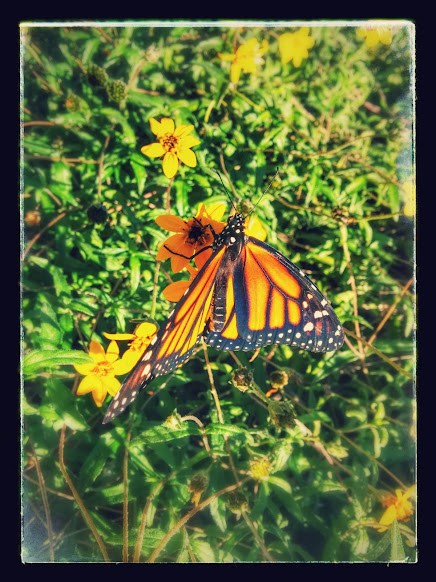
7 of the monarchs hatched on Sunday between 9 am and 2 pm. Another 2 emerged within a few hours after that. In the picture below, you can tell that the butterfly in the background has just recently emerged because its wings are all scrunched up, after another 15 minutes or so, the wings were completely unfurled and it looked like the one in the foreground. Because the weather was not ideal for butterfly release, I pushed the release to Monday...and then it was pouring on Monday so I had to wait until Tuesday. Of course, the problem with keeping butterflies for a few days is that they do need to eat - they won't need food the first 24 hours or so, but after that, you should place a sponge soaked in sugar water in the cage (I used hummingbird mix ratios - 1 part sugar, 4 parts water). Tuesday morning was bright, and a bit chilly, but all in all a good day for butterfly release. I managed to reach into the cage and pull out the cup (which still has 5 chrysalises on it), and the sponge and then walked outside with the covered cage.
I pulled off the top with a flourish. And the butterflies just sat there. Hunh. I guess it was early, and still a little chilly. So I waited, and carefully picked up some of them and put them on the zexmenia flowers. Most hung out for a little bit before flying up to sun themselves on the red tipped photinia. An hour or so later, they were all flitting about the yard.
Be well my little monarch friends, be sure to mate lots and lay lots of eggs. Bring those butterflies back!
And how does one tell that hatching is immanent? The chrysalises look like this:
 |
 |
I pulled off the top with a flourish. And the butterflies just sat there. Hunh. I guess it was early, and still a little chilly. So I waited, and carefully picked up some of them and put them on the zexmenia flowers. Most hung out for a little bit before flying up to sun themselves on the red tipped photinia. An hour or so later, they were all flitting about the yard.
 |
Be well my little monarch friends, be sure to mate lots and lay lots of eggs. Bring those butterflies back!
Update: Shawn mowed the lawn this evening (Wednesday - and just after I released another 3 butterflies) and told me that he's pretty sure he mowed over a monarch butterfly. sigh. I save them, he kills them. Wonderfu.
Tuesday, October 14, 2014
All Hail the Monarchs (Round 3)
Based on what you, the readers, wanted, I have done more monarch posts.
So, when we last left off, I had created the "chrysalis cage." All those caterpillars started to pupate, but then so did the remaining 'pillars...in their 'definitely not big enough for them to actually get out of their chrysalis' cages. Most of the caterpillars I caught while they were starting to make their little silk mats to hang from, and rather than stress them out by moving them after they had gotten their little minds in the mood by making their mats, I left them to chrysalise (not a real word) on the screen. I probably could have moved them at the 'just starting to create a silk mat' stage, but you definitely do not move them once they've hit the 'hanging out in J' stage.
Of course, letting them go to chrysalis in their little cages meant was that I would have to transfer the chrysalises to the pupating cage before they actually hatched. After having 12 caterpillars go into chrysalis without me seeing it, I finally caught the last one in mid-change:

Of course, you can't really see it all that well in a still photo, but it was really weird because it still all pulses and everything until it completely wiggles out of it's old skin. It will take about another 24 hours for the shell to harden completely before I could move it into the chrysalis cage. It should also be noted that in order to get this photo, my husband had to hold the screen up while I took a photo with my phone. We whispered the entire time because that's obviously what one does when watching a caterpillar begin its pupating phase - you whisper. The best part was while we're taking this photo, Shawn even whispered, "why are we whispering?"
So a few days after the last cat began to pupate, I started Operation: Move Chrysalis.

You can kinda see the extent of the silk mats in the photo above - they go out just a scosh past the width of the chrysalis. So the trick in moving them is to get the mat detached from the screen without dropping the chrysalises on the table. Surprisingly a pretty easy task when you have the correct tools (i.e. a straight pin). Of course, since I needed two hands to do the process, I didn't get a photo of it, but I basically just took the pin and pried at the silk which is surprisingly strong, and sticky, so all I had to do was press the silk together around the pin after I got the chrysalis off the screen. After getting the chrysalis off the screen, I stuck the pin in a branch I put in an old Thundercloud Subs cup with a rock in it for balance.

Pictures don't do the chrysalises justice - the yellow is actually sparkly gold, and the green is a consistent clear green color.

I then moved the cup into the chrysalis cage, so all my pupating butterflies are together. It's a little tight (especially for 13 chrysalises, and the resultant 13 butterflies); but hopefully not all the chrysalises will hatch at the same time - though I suppose they could since monarchs pupate from between 10 to 14 days.
Stay tuned; next time we talk about monarchs it will be hatching day.
So, when we last left off, I had created the "chrysalis cage." All those caterpillars started to pupate, but then so did the remaining 'pillars...in their 'definitely not big enough for them to actually get out of their chrysalis' cages. Most of the caterpillars I caught while they were starting to make their little silk mats to hang from, and rather than stress them out by moving them after they had gotten their little minds in the mood by making their mats, I left them to chrysalise (not a real word) on the screen. I probably could have moved them at the 'just starting to create a silk mat' stage, but you definitely do not move them once they've hit the 'hanging out in J' stage.
Of course, letting them go to chrysalis in their little cages meant was that I would have to transfer the chrysalises to the pupating cage before they actually hatched. After having 12 caterpillars go into chrysalis without me seeing it, I finally caught the last one in mid-change:
Of course, you can't really see it all that well in a still photo, but it was really weird because it still all pulses and everything until it completely wiggles out of it's old skin. It will take about another 24 hours for the shell to harden completely before I could move it into the chrysalis cage. It should also be noted that in order to get this photo, my husband had to hold the screen up while I took a photo with my phone. We whispered the entire time because that's obviously what one does when watching a caterpillar begin its pupating phase - you whisper. The best part was while we're taking this photo, Shawn even whispered, "why are we whispering?"
So a few days after the last cat began to pupate, I started Operation: Move Chrysalis.
You can kinda see the extent of the silk mats in the photo above - they go out just a scosh past the width of the chrysalis. So the trick in moving them is to get the mat detached from the screen without dropping the chrysalises on the table. Surprisingly a pretty easy task when you have the correct tools (i.e. a straight pin). Of course, since I needed two hands to do the process, I didn't get a photo of it, but I basically just took the pin and pried at the silk which is surprisingly strong, and sticky, so all I had to do was press the silk together around the pin after I got the chrysalis off the screen. After getting the chrysalis off the screen, I stuck the pin in a branch I put in an old Thundercloud Subs cup with a rock in it for balance.
Pictures don't do the chrysalises justice - the yellow is actually sparkly gold, and the green is a consistent clear green color.
I then moved the cup into the chrysalis cage, so all my pupating butterflies are together. It's a little tight (especially for 13 chrysalises, and the resultant 13 butterflies); but hopefully not all the chrysalises will hatch at the same time - though I suppose they could since monarchs pupate from between 10 to 14 days.
Stay tuned; next time we talk about monarchs it will be hatching day.
Sunday, October 12, 2014
Support your Independent Nursery Month: Barton Springs Nursery
Welcome to October: Support your Independent Nursery Month. Pam at Digging started SIN Month a few years ago to show all the benefits of going to an independently owned garden center as opposed to a big-box store. Some years there are even drawings and give-aways. I'm not sure what's on the agenda for this year (as to whether there are any give-aways or not), but I figured I'd go ahead and start blogging about the local garden centers in case you're new to town and want to get a start on fall planting.
I, personally, like going to the big box stores in order to ask them for things I know they won't have...like Milkweed. Milkweed is quickly becoming the most sought after butterfly plant, and big box stores just don't carry it. A HUGE oversight on their part. But if you keep going in and asking for it, in theory, they'll eventually carry it. Of course, I think it would help if the Grow Green folks added a "Butterfly Host Plants" section to their guide since I know the big box stores by my house hand out that guide, and try to carry a decent selection of the plants in that guide. And I'm sure I have an inside track on this since I WORK WITH THE PEOPLE WHO MAKE THE GUIDE. Jesus...you'd think that I'd have brilliant ideas like this more frequently, but alas and alack, I do not. [10 minutes later] Okay, I checked the guide, they do have "Mexican milkweed" as a recommended plant for the Austin area. But I still think they should have a little section on Butterfly host plants (much like they have a section on rain gardens).
Back to the issue at hand:
But you know who DOES carry milkweed? Your independent garden center.
They also have things right now like strawberries. Which you should plant now, not in January.
They also have garlic because now's the time to plant.
Anyhow, the garden center I'm highlighting this week is Barton Springs Nursery. BSN (as those of us in the Biz call it) is a quick jog from my office - I work at Barton Springs and Riverside. BSN is located on Bee Caves west of Walsh Tarlton and is usually quick and easy to get to (unless you're dealing with ACL traffic...so I'm really glad I decided to go there today at lunch instead of tomorrow at lunch). The Wild Birds Unlimited which used to be in the shopping center at Walsh Tarlton recently (like earlier this year) moved to the building adjacent to BSN, so now you can get all your plant and bird needs met with one trip.
Of course, I forgot that this is SIN Month, so I didn't take any photos while I was there...but I've highlighted them before (also no photos...damn).
Anyhow, my goal for today was to find more milkweed plants. My "Hairy Balls" plant I had through the spring and summer died and while I did just plant some plants in that area, I figure having additional milkweed isn't a bad thing*. Especially since I'm currently raising monarch caterpillars in the house and they eat a crap-ton of leaves. I found 4" pots and gallon-sized pots. Since I was looking for more leaves over more plants, I went with the gallon sized. Because it is a garden center which is in the business of trying to sell plants, they pick all the caterpillars off of their "for sale" plants and put them on their plants they have in the back which aren't for sale. Unfortunately, they had too many caterpillars and not enough plants, as in their plants were completely denuded, so they had 5th instar monarch caterpillars free to a good home. And that is how, even though I specifically got the plants to feed the ones I already had at home, I ended up with 3 more caterpillars to add to my menagerie.

*(aside: you have no idea how worried I was when I typed in "hairy balls plant" in the Google machine)
I, personally, like going to the big box stores in order to ask them for things I know they won't have...like Milkweed. Milkweed is quickly becoming the most sought after butterfly plant, and big box stores just don't carry it. A HUGE oversight on their part. But if you keep going in and asking for it, in theory, they'll eventually carry it. Of course, I think it would help if the Grow Green folks added a "Butterfly Host Plants" section to their guide since I know the big box stores by my house hand out that guide, and try to carry a decent selection of the plants in that guide. And I'm sure I have an inside track on this since I WORK WITH THE PEOPLE WHO MAKE THE GUIDE. Jesus...you'd think that I'd have brilliant ideas like this more frequently, but alas and alack, I do not. [10 minutes later] Okay, I checked the guide, they do have "Mexican milkweed" as a recommended plant for the Austin area. But I still think they should have a little section on Butterfly host plants (much like they have a section on rain gardens).
Back to the issue at hand:
But you know who DOES carry milkweed? Your independent garden center.
They also have things right now like strawberries. Which you should plant now, not in January.
They also have garlic because now's the time to plant.
Anyhow, the garden center I'm highlighting this week is Barton Springs Nursery. BSN (as those of us in the Biz call it) is a quick jog from my office - I work at Barton Springs and Riverside. BSN is located on Bee Caves west of Walsh Tarlton and is usually quick and easy to get to (unless you're dealing with ACL traffic...so I'm really glad I decided to go there today at lunch instead of tomorrow at lunch). The Wild Birds Unlimited which used to be in the shopping center at Walsh Tarlton recently (like earlier this year) moved to the building adjacent to BSN, so now you can get all your plant and bird needs met with one trip.
Of course, I forgot that this is SIN Month, so I didn't take any photos while I was there...but I've highlighted them before (also no photos...damn).
Anyhow, my goal for today was to find more milkweed plants. My "Hairy Balls" plant I had through the spring and summer died and while I did just plant some plants in that area, I figure having additional milkweed isn't a bad thing*. Especially since I'm currently raising monarch caterpillars in the house and they eat a crap-ton of leaves. I found 4" pots and gallon-sized pots. Since I was looking for more leaves over more plants, I went with the gallon sized. Because it is a garden center which is in the business of trying to sell plants, they pick all the caterpillars off of their "for sale" plants and put them on their plants they have in the back which aren't for sale. Unfortunately, they had too many caterpillars and not enough plants, as in their plants were completely denuded, so they had 5th instar monarch caterpillars free to a good home. And that is how, even though I specifically got the plants to feed the ones I already had at home, I ended up with 3 more caterpillars to add to my menagerie.
*(aside: you have no idea how worried I was when I typed in "hairy balls plant" in the Google machine)
Friday, October 3, 2014
All Hail the Monarchs
So a few weekends ago, I went to the Monarch Appreciation day at Zilker Botanical Gardens. While I was there, I talked a bunch with the Austin chapter of Native Plant Society of Texas, I listened to two presentations about the plight of the Monarch butterflies (Monarch Waystations by Chuck Patterson, and Wildlife Austin Habitat Challenge for Pollinators by Meredith Gray), and I purchased plants with the proceeds going toward the the Monarch Watch and Xerces Society. I also wandered around the various demonstration stuffs they had, such as this giant Monarch Bike:

The plants I purchased are Coral Honeysuckle (Lonicera sempervirens), Mealy Blue Sage (Salvia farinacea), Shrimp Plant (Justica brandegeeana), Tropical Milkweed (Asclepias curassavica), Firebush (Hamelia patens), and Boneset (Ageratina wrightii/Eupatorium serotinem - as far as my research shows, these are the same plant?). Or at least I THINK these are all the plants I bought because it was rainy when I bought them all and I put the plants outside on the deck after I got home so of course all the name stickers washed off.
I any case, I planted the sage and the honeysuckle, and I have to find a place for the firebush since it's the normal sized one, not the "nana" variety. The boneset and the shrimp plant will go over in the shady part of the yard, I just don't know precisely where...This is precisely why I have a plan. But you can see how good I am about following plans...
The plants I purchased are Coral Honeysuckle (Lonicera sempervirens), Mealy Blue Sage (Salvia farinacea), Shrimp Plant (Justica brandegeeana), Tropical Milkweed (Asclepias curassavica), Firebush (Hamelia patens), and Boneset (Ageratina wrightii/Eupatorium serotinem - as far as my research shows, these are the same plant?). Or at least I THINK these are all the plants I bought because it was rainy when I bought them all and I put the plants outside on the deck after I got home so of course all the name stickers washed off.
I any case, I planted the sage and the honeysuckle, and I have to find a place for the firebush since it's the normal sized one, not the "nana" variety. The boneset and the shrimp plant will go over in the shady part of the yard, I just don't know precisely where...This is precisely why I have a plan. But you can see how good I am about following plans...
Thursday, June 12, 2014
Attracting Butterflies to the Garden
How to attract butterflies to the garden:
1. Plant Gregg's Mistflower. The mistflower I have in the back (i.e. full sun) is blooming right now. The mistflower in the front (i.e. dappled sun) isn't blooming, nor will it until the fall.

2. Plant Butterflyweed. Oh my God. This plant is ALWAYS COVERED in aphids. But! Aphids eventually bring lady bugs and lacewings. And, of course, it is the host plant for the monarchs, and they need as much help as they can get.


3. Plant Dill, Parsley, or Fennel (though I've found that Dill works the best). When it blooms, it brings the bees, and until it does, it will host all those swallowtail caterpillars. And eventually, you'll find a few of these on other plants (the swallowtails sure like to travel to a different location to pupate).

1. Plant Gregg's Mistflower. The mistflower I have in the back (i.e. full sun) is blooming right now. The mistflower in the front (i.e. dappled sun) isn't blooming, nor will it until the fall.
2. Plant Butterflyweed. Oh my God. This plant is ALWAYS COVERED in aphids. But! Aphids eventually bring lady bugs and lacewings. And, of course, it is the host plant for the monarchs, and they need as much help as they can get.
3. Plant Dill, Parsley, or Fennel (though I've found that Dill works the best). When it blooms, it brings the bees, and until it does, it will host all those swallowtail caterpillars. And eventually, you'll find a few of these on other plants (the swallowtails sure like to travel to a different location to pupate).
Wednesday, November 27, 2013


Wednesday, October 23, 2013
Passionvine

Another host plant - this one for the Gulf Fritillary. Passionvine. This one isn't the native variety (though it is native to South America, so it could easily have found its way here eventually); I believe this one is Blue Passionvine. The Fritillaries don't care. To them, it's just food. Beware - as with most passionvines, it can be a bit invasive and spreads most by roots - surprisingly I've found that this one spreads by roots, but will pop up like 3' away from the mother plant.
Tuesday, October 15, 2013
Plant This: Milkweed (aka SAVE THE MONARCHS!)
Dude. I don't know if you've heard yet, but the Monarchs need our help.* They have been taking some devastating hits to their population over the last few years. And by devastating, I mean like over 60% of the population just gone. We're talking worse than the Black Death here, people.
Providing adult food sources is a good start - they tend to LOVE Gregg's Mistflower. Other good plants seem to be Shrubby Boneset (also called White Mistflower), a whole host of daisy-like plants (disc shaped that are wide and flat), and even Lantana and Turk's Cap (though it tends to be frequented more by the Fritillaries).
BUT! If you REALLY want to help the monarchs, you'll also plant host plants. Or, in other terms, the plant that the caterpillars will eat (it never ceases to amaze me how many people will plant host plants only to get upset when they're munched down to nubbins by the insect they are hosting). The Monarchs only lay eggs on milkweed plants. And yes, your milkweed plants will be chewed down to twigs. BUT! you'll be helping the monarchs, which is really more important anyway. Gardening for nature is why you garden, isn't it?

Grouping your plants together to create large masses of the same color will help attract butterflies since they are near sighted (that's probably why they like the mistflowers - the plants create a large grouping all by themselves). Plant some milkweeds close by, add some dishes of water with some rocks in them (for the butterfly to perch on)and Voila! Instant Butterfly garden. If you want to get really ambitious, you can add throw out some fruit trimmings, leave one spot of dirt that isn't covered by mulch (for puddling), and a large clumping grass (for protection at night), and you'll have a garden that the Monarchs will flock to.

* okay, right now probably isn't really the time to plant things like milkweed, but it IS time to plant most perennial plants like the shrubby boneset and lantana. Plus some future planning is always a good thing.
Providing adult food sources is a good start - they tend to LOVE Gregg's Mistflower. Other good plants seem to be Shrubby Boneset (also called White Mistflower), a whole host of daisy-like plants (disc shaped that are wide and flat), and even Lantana and Turk's Cap (though it tends to be frequented more by the Fritillaries).
BUT! If you REALLY want to help the monarchs, you'll also plant host plants. Or, in other terms, the plant that the caterpillars will eat (it never ceases to amaze me how many people will plant host plants only to get upset when they're munched down to nubbins by the insect they are hosting). The Monarchs only lay eggs on milkweed plants. And yes, your milkweed plants will be chewed down to twigs. BUT! you'll be helping the monarchs, which is really more important anyway. Gardening for nature is why you garden, isn't it?
Grouping your plants together to create large masses of the same color will help attract butterflies since they are near sighted (that's probably why they like the mistflowers - the plants create a large grouping all by themselves). Plant some milkweeds close by, add some dishes of water with some rocks in them (for the butterfly to perch on)and Voila! Instant Butterfly garden. If you want to get really ambitious, you can add throw out some fruit trimmings, leave one spot of dirt that isn't covered by mulch (for puddling), and a large clumping grass (for protection at night), and you'll have a garden that the Monarchs will flock to.
* okay, right now probably isn't really the time to plant things like milkweed, but it IS time to plant most perennial plants like the shrubby boneset and lantana. Plus some future planning is always a good thing.
Wednesday, August 7, 2013


Subscribe to:
Posts (Atom)